
Do Couples Share Gut Bacteria?
Living together can make two microbial worlds overlap.
Compatibility tests usually ask about values, money, kids, and whether someone loads the dishwasher like a civilized adult. Microbiome science adds a stranger layer: couples may become more microbially similar when they share a life.
Cohabitation changes exposure
People who live together share food, surfaces, air, routines, and physical closeness. Studies of households and social networks suggest that those shared exposures can show up in microbial similarity.
The effect is not destiny. Two partners can still have very different guts because diet, medications, stress, and biology all matter.
The romance is in the routine
The microbiome angle is less about a single kiss and more about the life around it: what you cook, when you sleep, how often you move, and what foods become normal in the house.
A couple that starts eating more plants and ferments together is not just making a cute grocery list. They are changing the ecosystem they both live in.
A date-night idea with actual utility
Build a meal around contrast: protein, fiber, acid, crunch, and something fermented. Steak and kraut, lentil bowls with fermented salsa, or noodles with miso vegetables all count.
The point is not to make dinner clinical. It is to let good food carry the health habit.
- Couples can become more microbially similar through shared environments and routines.
- Shared meals may matter more than one-off wellness habits.
- Gut-friendly date nights can be practical, flavorful, and very unpretentious.
- 1.Song SJ, Lauber C, Costello EK, et al. (2013). Cohabiting family members share microbiota with one another and with their dogs. eLife.
- 2.Brito IL, Gurry T, Zhao S, et al. (2019). Transmission of human-associated microbiota along family and social networks. Nature Microbiology.
Wild Origin makes microbiome testing and foods for wellness education, not medicine. This article is for curiosity and education — it is not medical advice, and our products are not intended to diagnose, treat, cure, or prevent any disease. If you are managing a health condition, talk to a qualified clinician.
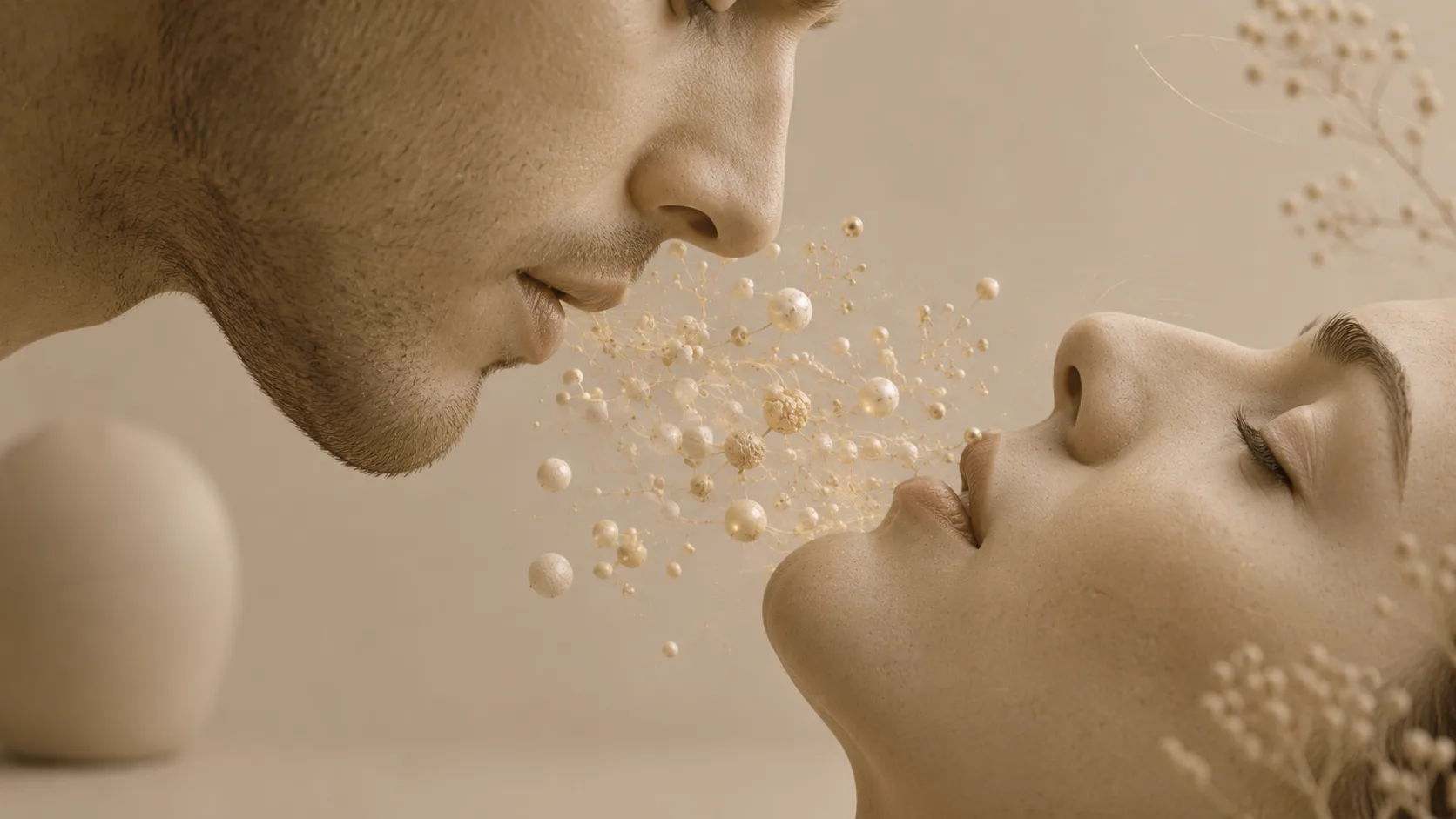
The Microbiology of a Kiss
A ten-second kiss swaps around 80 million bacteria — here's what you're really sharing with a partner.

The Date-Night Gut: Food, Kissing, and Microbes
A less awkward way to think about chemistry.